I Have No Choice but to Extend My Anxiety into Tomorrow
On September 14, 2026, Liu Shengyu — an operator engineer at DeepSeek and a graduate of Peking University’s Turing Class — published an article on his personal WeChat account, “intlsy’s Doghouse”: “I Had to Bury My Talent in Yesterday” [1].
The article spread through the community almost instantly and went viral, with interpretations pouring out in droves. Even Liu himself probably never imagined, before hitting publish, that his worries about one’s place in the AI era would break out of the circle and catch fire.
As the wave receded, I reread the article, along with the follow-up note he wrote after it went viral [2], and a few thoughts took shape — call them reading notes, if you like.
At First, No One Cared About the Disaster
At first, no one cared about this disaster. It was nothing but a wildfire, a drought, the extinction of a species, the disappearance of a city — until the day the disaster bound itself to everyone.
These are the opening lines of The Wandering Earth. And just like the words themselves — at first, nobody paid these words any attention either.
In the AI era, most industries, skills, and jobs will be reshaped. From GPT-1’s ultra-short context window to today’s Opus and GPT-6 series: four or five years, no more. And within those four or five years, the field was also wrestling with compute shortages, incomplete AI infrastructure, talent gaps, and a string of other problems. Hard as it is to imagine, with both China and the United States raising their bets on AI, how fast will the AI of the future keep evolving?
One refrain is never hard to find: “AI is just a toy. Humans can never be replaced.”
It reminds me of embodied AI. Today’s embodied robots live under a constant drizzle of doubt — “bubble,” “toy,” “useless.” As an engineering student who follows technology, my humble take is that embodied AI is bound for enormous growth and an enormous market — just as Feng Ji predicted the Chinese single-player game market back in 2018, I now make my prediction about the embodied-AI market of the future.
Let us rewind the timeline to 1831.
After Faraday discovered electromagnetic induction — motion generating electricity — he demonstrated his new invention at a public lecture: the first crude generator model in human history. A lady in the audience (some say it was William Gladstone, then Britain’s Chancellor of the Exchequer) asked, puzzled:
“Mr. Faraday, this spinning coil of wire is certainly amusing — but what, after all, is it good for?”
Faraday answered with humor and depth:
“Madam, what good is a newborn baby?”
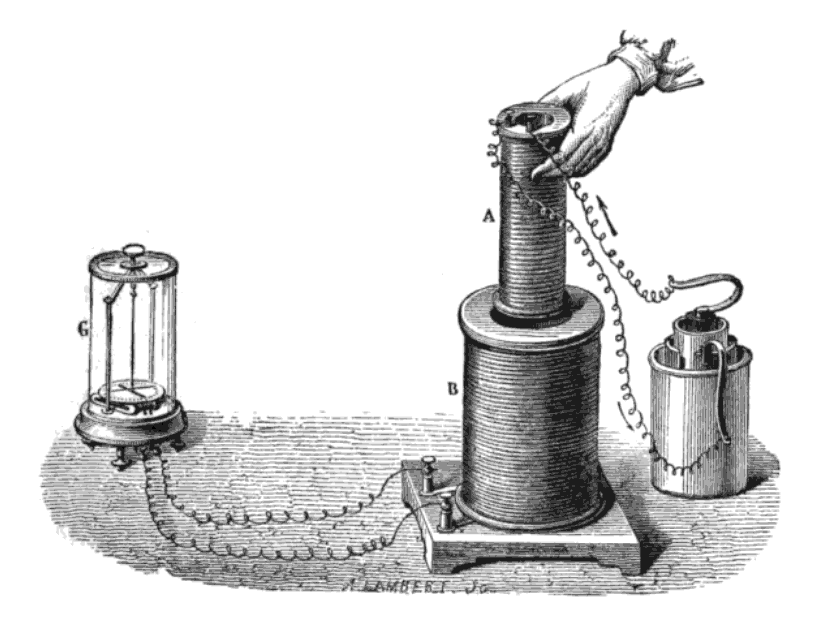
Fig. 1: Engraving of Faraday’s electromagnetic induction apparatus (drawn by J. Lambert, 1892): B is the iron ring, A the coil wound upon it, G the galvanometer. Source: Wikimedia Commons, “Induction experiment” (public domain) [3].
I suppose this is one of the grounds on which I dare predict the future of embodied AI.
A Person Knitting a Sweater
Back to the article itself. Liu Shengyu graduated from Peking University with excellent grades and solid craft, and joined DeepSeek after graduation to work on operator design — the main attention operator of DeepSeek v4.1 came from his hands. Yet right after v4.1 shipped, the very author of that operator sank into deep self-doubt: AI keeps getting stronger, and before long, the operators AI writes will surpass his own. He faced a simple state of affairs — revolutionize yourself, or be revolutionized by your peers.
Fig. 2: DeepSeek’s official brand image. Source: DeepSeek website [4].
One metaphor in the original stayed with me long after reading:
You have mastered the craft of knitting sweaters, especially skilled at patterns of every kind and pairings of every color. … Then one day, someone invents a wondrous machine: give it yarn and a pattern, and it knits a sweater on its own — quality and texture no worse than your handiwork, and far faster. … But that quiet pleasure of listening to the rain by the window, of threading the needle, of letting time pass slowly — crushed, in the end, beneath the roar of the machine.
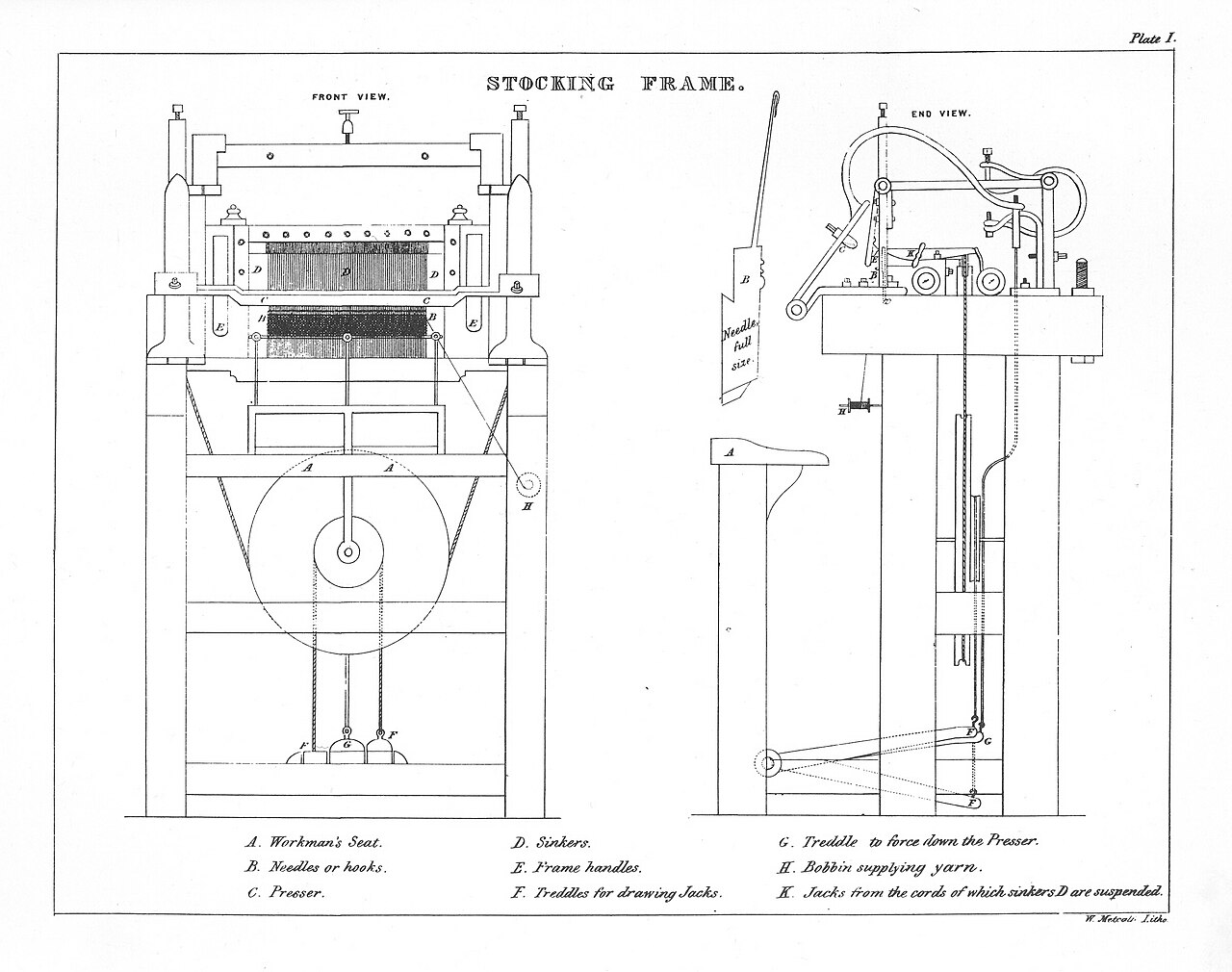
Fig. 3: Engraving of the structure of Lee’s stocking frame (1867): A the worker’s seat, B the needles, C the presser, G the treadle. Invented by William Lee in 1589, it stands as an early emblem of machines displacing hand knitting. Source: Wikimedia Commons, “Lee’s knitting frame” (CC0) [5].
His judgment of himself is calm to the point of cruelty: he won’t quite “lose his job,” but he must “change trades.” The rice bowl can be kept; the old love will most likely have to be abandoned. In his own words — “I had to bury my talent in yesterday and become a mecha pilot. My hands gained a few gears, but my heart lost its rhythm.”
If even a top expert like him must go through this, what about the rest of us — the millions of ordinary people?
Tacit Knowledge: the Ordinary Person’s Moat?
At school I’ve been fortunate to meet quite a few cross-disciplinary powerhouses. Besides using AI like everyone else — Claude Code, Codex — they nearly all share one ability ordinary people lack: professional tacit knowledge (I picked up the term from a blogger I used to follow; sadly I’ve forgotten who).
This tacit knowledge, I think, is precisely the part of us that differs from AI and cannot be replaced by it.
It also explains why, with the same AI, some people ship projects that harvest tens of thousands of stars, while others can’t even produce a decent slide deck.
So what is professional tacit knowledge?
Roughly this: the knowledge — the experience — within a profession or industry that textbooks never write down, teachers never teach, and even those who have it cannot quite articulate.
Take the owner of a jianbing stall. A seasoned vendor flips fast, and the taste stays steady. Ask how they judge the heat of the griddle, or what counts as “done,” and they might stammer for half a day without an answer — yet there they are, flipping and seasoning at exactly the right moment.
The example may be imperfect, but I think the idea comes through.
And this kind of tacit knowledge is what people acquire through endless trial and learning in the concrete, physical world — knowledge that refuses to be dictated into words and written down.
Which strikes precisely at the soft rib of today’s large models: AI learns and trains from vast amounts of human knowledge — text, images, video — and anything an AI holds must be quantifiable, translatable into binary.
Will Engineering Skill Be Discarded Like x86 Assembly?
Liu Shengyu writes in the original:
Are students today, by and large, more inclined to use AI to finish assignments — especially the hands-on labs? Picture the choice before them: on one side, eight grueling hours on a lab, with full marks perhaps still out of reach; on the other, fire up an AI model and, for a few cents and a few minutes, have it write perfect code. Which would most students choose? What follows is that vast numbers of students will end up gravely short of engineering ability — the ability to organize code, to build systems, to anticipate future needs and design for them ahead of time, to abstract. So as AI keeps getting stronger, is this “engineering ability” still necessary? Will it be discarded by the era like the old skill of “fluently writing x86 assembly,” or will it hold lasting value like “understanding the whole computer system, from software to OS to hardware”? If the latter, it is dangerous indeed — a person with poor engineering ability, paired with AI, can produce mountains of garbage code several times faster than before, planting every manner of landmine in the system and making the world even more of a makeshift stage. In the society of the future, will power matter more than technology or intelligence? Perhaps these are questions only the era itself can answer.
Here I share the same worry (me too, exactly). What an engineering student needs most is not repetitive, exhausting labor — it is the personal system distilled from that repetitive technical work: an architectural mind. Hand them a project, and they know whether it is feasible, they know the technical approaches the world uses on similar problems, they know how to choose the overall architecture.
As AI grows more capable and tools like multimodal models, computer use, and agents keep evolving, the engineering student who no longer spends time hunting tutorials, chewing through code, and trying things hands-on loses something no AI, however powerful, can restore — because that was the process of an individual internalizing an unfamiliar field into intuition, step by step. Once outsourced, that process never comes back.
But the Moat Is Not Permanent
Still, treating “tacit knowledge” as a lifetime get-out-of-jail card would be a little too optimistic.
Liu’s operators are better than AI’s today — what about tomorrow? Multimodal models are learning to “watch” video; world models are learning physics; and the teleoperation data of embodied AI is turning the human sense of touch, bit by bit, into trainable samples. The irony is sharp: the very field I’m so bullish on, embodied AI, is precisely in the business of “converting the physical world’s tacit knowledge into data.” That city called “tacit knowledge” is being nibbled away, inch by inch.
So I’ve slowly come to feel that the real moat was never some static lump of knowledge — it is the habit of continually acquiring tacit knowledge: hunting tutorials, chewing through code, trying things hands-on, banging into walls in the real physical world. Knowledge will be turned into data, but “willingness to do the dumb, slow work” is, for now, something no one can do on your behalf.
A Farewell Misread
The day after the article went viral, Liu published a follow-up: well over a hundred thousand reads on WeChat, number one on Zhihu’s trending list. But he sounded rather helpless — what people focused on was not aligned with what he wanted to say.
My purpose in writing this piece was never to express anxiety about unemployment, still less to praise DeepSeek’s openness while lamenting Anthropic’s prickliness. I wanted to say goodbye to those days of writing operators by hand.
On my first read, like most people, I saw only the word “anxiety.” Rereading after the wave receded, I finally saw it: what he wrote was not anxiety but farewell. Anxiety is an emotion facing the future; farewell is a ritual facing the past. He was raising a monument to “that quiet joy of sitting at a desk and writing operators all afternoon” — so that the self of ten or twenty years from now would still have a place to revisit.
Among the comments was one he liked, and I like it too:

Fig. 4: A comment from the WeChat comment section: “Like a lull in some battle…” (279 likes). Source: screenshot from Liu Shengyu’s “A Follow-up to ‘I Had to Bury My Talent in Yesterday’” (2026-09-15) [2].
Like a lull between two waves of a battle: a soldier in the corner of a trench, writing the arc of his character on tattered paper, his rifle standing beside him.
Reading to this point, a more piercing thought occurred to me: Liu Shengyu at least possessed a love worth bidding farewell to. And the root of anxiety for most of us is precisely that we hold nothing yet that AI could take away.
Extending Anxiety into Tomorrow
The original is titled “I Had to Bury My Talent in Yesterday”; for these reading notes, I retitled it “I Have No Choice but to Extend My Anxiety into Tomorrow.”
Burying talent in yesterday is the farewell forced upon him; extending anxiety into tomorrow is the choice we can still make ourselves. Don’t let anxiety die tonight in doomscrolling and inner friction — turn it into one concrete item on tomorrow’s list: build a small project, chew through a piece of hardcore code, write a blog post (this one is), or simply write down what the lab teaches that no textbook does. A moat can only be dug out one shovel at a time.
At the end of his follow-up, Liu writes that he still has “tomorrow’s light to chase.” A man who buried his own love with his own hands can say that — we have even less reason to stand still.
At first, no one cared about this disaster, until the day it bound itself to everyone.
Now, it has finally bound itself to everyone.
So — starting tomorrow. No: starting now.
References
[1] 刘胜与. 我不得不把才华埋葬在昨天[EB/OL]. 微信公众号「intlsy 的狗窝」, 2026-09-14. https://mp.weixin.qq.com/s/zk0KxuLzhmMJ4LPYW_OHMA.
[2] 刘胜与. 对《我不得不把才华埋葬在昨天》的补充说明[EB/OL]. 微信公众号「intlsy 的狗窝」, 2026-09-15. https://mp.weixin.qq.com/s/hZWOsM8KP5py7mDyZbRTtA.
[3] LAMBERT J. Induction experiment[DB/OL]. Wikimedia Commons, 1892. https://commons.wikimedia.org/wiki/File:Induction_experiment.png.
[4] DeepSeek. Official brand image[DB/OL]. https://www.deepseek.com.
[5] Lee’s knitting frame[DB/OL]. Wikimedia Commons, 1867. https://commons.wikimedia.org/wiki/File:Lee's_knitting_frame.jpg.
The cover image “Buried in Yesterday” is the original cover of ref. [1]; Fig. 4 is an illustration from ref. [2].